China Top Black Rectangular Hollow Section Supplier?
Choosing a China-based supplier for Black Rectangular Hollow Section requires more than comparing prices. Buyers should examine steel grade, wall-thickness tolerance, corner shape, coating consistency, and traceable inspection records. Ask for recent mill test certificates and sample measurements. A tape measure, caliper, and coating-thickness gauge can reveal details a polished product photo cannot. Small checks matter.
Engineering standards offer a useful lens. Aerospace engineer and applied mathematician Theodore von Kármán said, “Scientists study the world as it is; engineers create the world that has never been.” His words are not about hollow sections specifically, but they capture why product claims need practical verification. A supplier’s catalog is a starting point, not proof of production capability.
This guide examines how to assess Chinese manufacturers of Black Rectangular Hollow Section, including fabrication capacity, quality controls, export experience, and communication. Compare suppliers against the same specification, then request evidence for each critical requirement. Look closely at cut ends, weld seams, and coating around corners. There is no single “top” supplier for every project. A strong match depends on dimensions, quantity, finish, delivery schedule, and the buyer’s inspection needs. Even a well-documented supplier may need closer review when specifications are unusual. That part is easy to overlook.
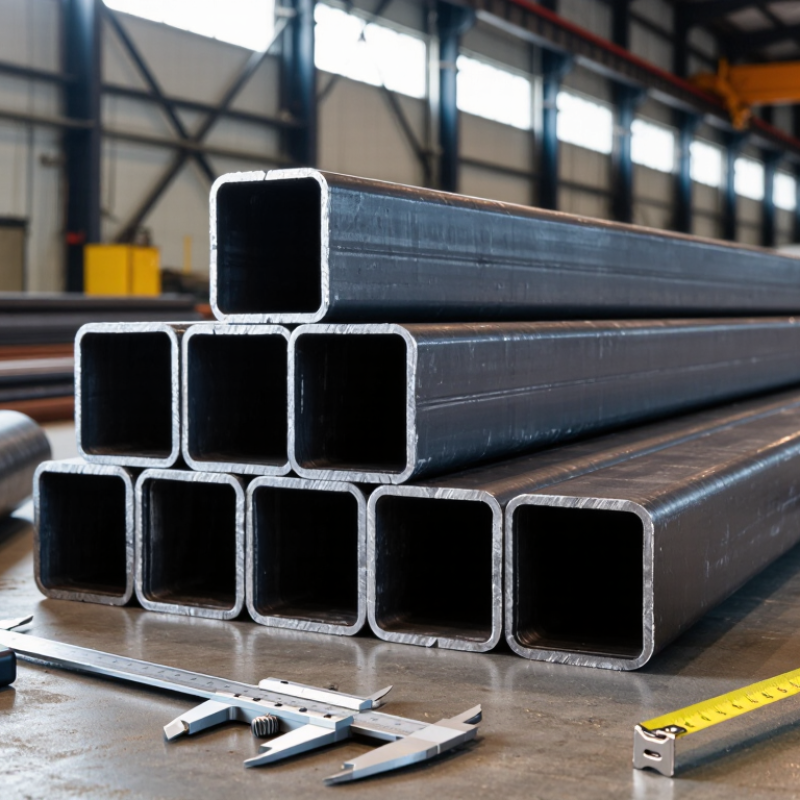
What Is a Black Rectangular Hollow Section?
A black rectangular hollow section, or RHS, is a closed steel tube with a rectangular cross-section. “Black” usually describes its untreated, dark mill finish, often with visible oxide scale. It does not mean the section is necessarily painted black. Not a coating. The hollow core keeps the member relatively light while its flat faces provide practical surfaces for connecting plates, brackets, and other components.
RHS is commonly used in building frames, equipment supports, gates, and general fabrication. Its performance depends on dimensions, wall thickness, steel grade, and manufacturing quality—not appearance alone.
The World Steel Association’s World Steel in Figures 2024 reports global crude steel production of 1,892.2 million tonnes in 2023. That figure describes crude steel, not RHS production, but it shows the scale of the material supply chain behind structural products.
When checking a section, confirm its outside width and height, wall thickness, straightness, and whether the grade meets the project specification. Look closely at the corners and weld seam; small differences can affect fit-up and fabrication. A material certificate can help verify the supplied grade and test results. Still, “black” is not a precise technical grade, and mill finishes can vary. Details matter.
How Black Rectangular Hollow Sections Are Manufactured
Black rectangular hollow sections begin as steel coils or flat strips, selected for thickness, grade, and intended load. The strip is uncoiled and leveled, then passes through forming rolls that gradually shape it into a rectangle. Its edges meet along one side. An electric-resistance welding process joins the seam, usually without adding filler metal. Small variations matter.
After welding, sizing rolls refine the section’s width, height, and corner shape. The tube is cut to specified lengths, and operators check straightness, dimensions, and weld appearance. Some lines use automated gauges; visual checks still help catch surface marks or irregular ends. A slight bow can occur, so pretending every piece is perfect would be misleading.
The black surface may come from mill scale on hot-formed steel or from a protective coating applied after cleaning. These finishes are not identical: scale can vary in tone, while paint gives a more controlled appearance. Before shipment, samples may be checked for coating coverage, wall thickness, and cut quality. Clean edges and consistent dimensions make installation easier. The finish deserves attention too. It can be scratched during handling, even when the section passed inspection.
Which Standards and Specifications Define Product Quality?
For a black rectangular hollow section, quality starts with the correct product standard. ASTM A500 is commonly specified for cold-formed structural tubing, while EN 10219 covers cold-formed welded structural hollow sections. EN 10210 applies to hot-finished sections. These standards are not interchangeable. Match the specification to the project, destination market, and design requirements. Check the grade, outside dimensions, wall thickness, length, and permitted tolerances. A section that looks square on a rack may still fall outside the required dimensional limits.
Ask for a test certificate that identifies the grade and heat number, then compare it with the purchase specification. EN 10204 Type 3.1 is a certificate format; it does not define the section’s manufacturing quality by itself. Look for relevant chemical and mechanical test results, plus clear traceability. Small details matter. At receiving, use a caliper to check wall thickness and dimensions at several points, and inspect the weld seam and cut ends. “Black” usually describes an uncoated mill finish, so confirm the expected surface condition and storage protection. A certificate helps, but it cannot replace inspection. I would also record any mismatch, even a minor one; small inconsistencies can be easy to overlook.
Where Are Black Rectangular Hollow Sections Commonly Used?
Black rectangular hollow sections are widely used where a clean profile and useful strength are needed. Their flat faces make them convenient for welded frames, support posts, gates, and equipment stands. In a workshop, a fabricator can align the tube against a jig and join it to a flat plate without complicated shaping. They fit neatly.
Building projects often use these sections for light structural frames, canopies, partitions, and handrail supports. The closed shape resists twisting better than many open profiles of similar size, though the right section still depends on load, span, and connection details. A small canopy may need different wall thicknesses from a long equipment platform. It is easy to underestimate that difference.
Black rectangular hollow sections also appear in vehicle bodies, agricultural equipment, storage racks, and modern furniture. Their dark mill finish can suit an industrial look, but it is not a substitute for corrosion protection. Outdoor parts may need a suitable coating, especially around cut edges and welds where moisture can collect. Check dimensions and wall thickness before fabrication; tolerances and finish can vary. That matters. A practical choice is not always the lightest one, and this is worth reviewing against the actual use.
Common Black Rectangular Hollow Section Sizes and Theoretical Mass
Black rectangular hollow sections are commonly used in building frames, supports, gates, railings, and trailer structures. The chart compares the estimated theoretical mass per metre of selected nominal sizes. Values are calculated using a steel density of 7,850 kg/m³ and sharp-corner geometry; actual product mass can vary with corner radii and manufacturing tolerances.
How to Evaluate a Leading Supplier in China?
A leading supplier should make its product specifications easy to verify. Start with the exact dimensions, wall thickness, steel grade, length, and required quantity. Clarify what “black” means in the quotation, since surface condition and protection during shipping can vary. Ask whether dimensions follow a stated tolerance and request a recent inspection report or mill test certificate for the proposed material.
Check the details, not just the price. Small gaps matter. Compare the quoted section size with your drawings, and ask how the supplier checks wall thickness and squareness during production. A sample can help reveal rough edges, uneven corners, or surface marks before a larger order is placed. It may not represent every bundle, though, so ask about routine quality checks as well.
Reliable communication is part of the evaluation. Ask for a realistic production schedule, bundle weight, packing method, and loading photos when available. Confirm how changes or defects are recorded and handled. References from comparable buyers can offer useful context, but verify what they actually purchased. A polished catalogue is not enough; written specifications and consistent inspection records provide a firmer basis for comparison.