What is Flotation Equipment and How Does It Work?
Flotation Equipment plays a crucial role in the mineral processing industry. It enables the separation of valuable minerals from waste materials with efficiency. The process relies on the differences in the surface properties of the materials. Understanding how flotation equipment operates is key for those involved in mining and mineral recovery projects.
The basic principle involves creating bubbles that attach to the desired particles. This attachment causes the particles to rise to the surface, where they can be collected. Effective flotation can lead to significant gains in metal recovery. However, designing and operating this equipment can be complex. Skilled operators must closely monitor parameters like pH, and reagents.
Despite its advantages, flotation equipment requires constant refinement. There are times when the process may not generate expected results. Factors such as feed composition can impact efficiency. Ongoing treatment and analysis are essential to improve performance. Mastering the art of flotation remains a challenge for professionals in the field. They must continuously adapt techniques and technologies to maximize results.
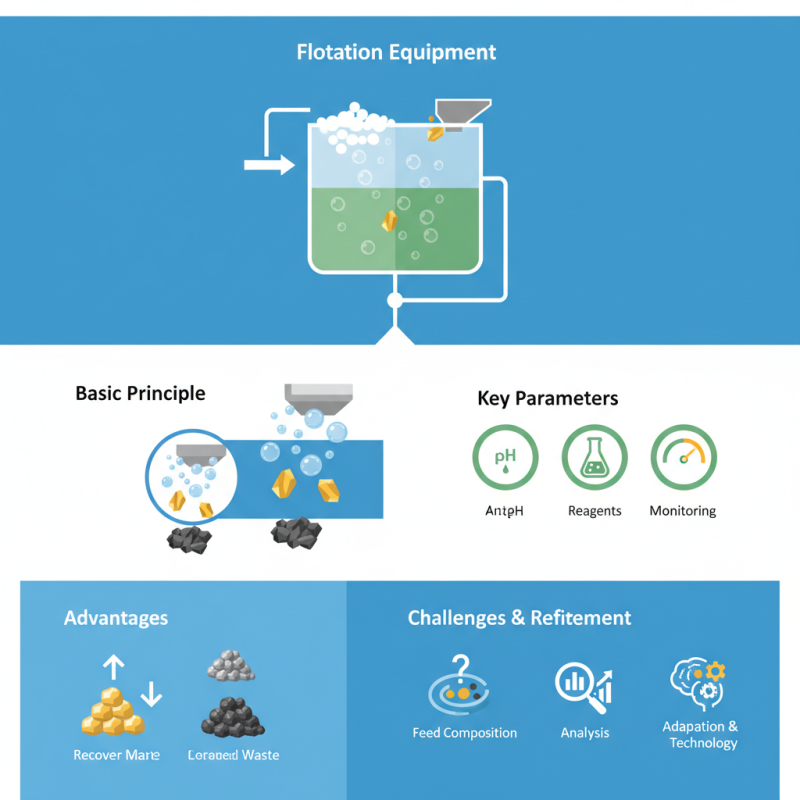
Definition of Flotation Equipment and Its Purpose
Flotation equipment is crucial in mineral processing. It facilitates the separation of valuable minerals from ores. The process hinges on the principles of hydrophobicity and hydrophilicity. Miners often rely on the efficiency of these machines to maximize yields and reduce waste. According to a 2022 industry report, flotation accounts for over 70% of the global mineral extraction process.
The primary purpose of flotation equipment is to harness the unique properties of minerals. By introducing air bubbles into a slurry, hydrophobic particles adhere to the bubbles and rise to the surface. This process can recover about 90% of the desired minerals from the ore. However, not all operations achieve optimal results. Some may struggle with froth stability or reagent dosage. These issues can hinder recovery rates.
In recent years, there has been a shift towards more advanced flotation technologies. Innovations aim to increase efficiency and recycle water. Yet, operators must adapt to these changes carefully. Utilizing outdated methods can lead to significant losses. Therefore, ongoing training and knowledge-sharing among professionals are essential. It’s critical to keep abreast of the latest advancements and operational best practices.
Types of Flotation Equipment Used in Mining and Mineral Processing
Flotation equipment plays a crucial role in mining and mineral processing. Various types of Flotation Machines are used to separate valuable minerals from ore. The two primary types include mechanical and column flotation cells. Mechanical cells provide agitation and aeration, producing bubbles that capture minerals. Column cells, on the other hand, use a vertical configuration to enhance the separation process, often yielding higher recovery rates.
Recent reports indicate that flotation equipment markets are expanding. According to a study by Research and Markets, the flotation equipment market is projected to grow at a compound annual growth rate (CAGR) of 4.5% from 2021 to 2026. The adoption of advanced technologies, like automation and real-time monitoring, is influencing this growth. However, challenges remain. Ensuring the optimal operation of flotation cells requires continuous adjustments based on feed characteristics.
Additionally, there are inherent complexities in flotation processes. The nature of the ore can significantly affect the efficiency of separation. Variability in particle size and mineralogy often leads to inconsistent results. Thus, operators must engage in constant monitoring and adjustments. Despite advancements, the need for skilled personnel remains essential, as human expertise can improve the decision-making process in real time.
Types of Flotation Equipment Used in Mining and Mineral Processing
This chart illustrates the efficiency percentages of various types of flotation equipment used in mining and mineral processing. The data suggests that the Jameson Cell offers the highest efficiency among the listed equipment, followed closely by Dissolved Air Flotation and Flotation Cells.
How Flotation Equipment Separates Materials: The Basic Principles
Flotation equipment plays a crucial role in the mineral processing industry. It primarily separates materials based on their hydrophobic properties. In simple terms, it helps to float certain minerals while sinking unwanted materials. This process is essential for obtaining pure metal ores from mined rocks.
The basic principles of flotation involve adding chemicals to a slurry of crushed ore and water. These chemicals, known as collectors, attach to the desired minerals, making them hydrophobic. Air bubbles are introduced into the mix, allowing these bubbles to adhere to the coated minerals. Eventually, the bubbles rise to the surface, forming a froth that can be skimmed off. The effectiveness of this method depends on various factors, including pH levels, particle size, and the type of reagents used.
However, results can be unpredictable. Not all ores respond well to flotation. Some minerals may not attach to air bubbles, leading to lower recovery rates. Additionally, the process can be influenced by factors such as temperature and agitation. Therefore, optimizing flotation processes often requires careful experimentation and adjustment. This complexity is what makes flotation both fascinating and challenging for engineers and operators in the field.
Key Components and Operation of Flotation Machines
Flotation machines play a critical role in the mining and mineral processing industry. They are designed to separate particles based on their hydrophobic properties. The fundamental operation relies on the generation of bubbles that attach to these particles, allowing them to rise to the surface and form a froth layer.
Key components of flotation machines include the rotor, stator, and air supply system. The rotor creates turbulence and airflow, enhancing bubble generation. According to industry reports, efficient rotor designs improve recovery rates by up to 15%. The stator stabilizes the bubble size, crucial for optimal separation. A properly calibrated air supply ensures that bubbles form at the right size for optimal attachment.
Operational parameters like pH, temperature, and reagent concentration significantly impact efficiency. A recent study indicated that adjusting pH levels can increase recovery rates significantly, sometimes by over 20%. However, challenges still exist. Overdosing reagents can lead to excessive froth, complicating the separation process. Operators must constantly monitor these variables to maintain optimal performance.
Applications and Benefits of Flotation Technology in Industry
Flotation technology is widely used across various industries. It plays a crucial role in mineral processing, wastewater management, and even recycling. This method separates materials based on differences in buoyancy. In mineral processing, for example, flotation equipment can isolate valuable ores from waste rock. It improves recovery rates, making it a preferred technique in mining.
The benefits extend beyond just efficiency. Flotation can also reduce environmental impact. By treating wastewater effectively, industries minimize pollution. This helps meet regulatory standards and supports sustainability. Additionally, flotation technology is adaptable. It can be tailored for different materials and processes, allowing for increased flexibility.
However, flotation does have challenges. Optimizing the parameters for specific applications can be complex. It requires expertise and constant monitoring. Variations in feed quality may affect outcomes. This means that industries must continuously refine their processes. Investing in training and technology is essential for maximizing flotation effectiveness.