China’s automation industry now serves factories across electronics, packaging, logistics, automotive, and medical equipment. Buyers can find capable partners for robotic arms, vision systems, conveyors, PLC controls, and complete production lines. The challenge is choosing suppliers that deliver consistent engineering, not attractive brochures.
This guide examines China’s best innovative automation suppliers through practical buyer criteria. These criteria include manufacturing experience, technical teams, quality systems, export records, installation support, and after-sales service. A reliable supplier should explain cycle times, accuracy limits, spare-part availability, and integration requirements clearly. Factory audits can reveal details that websites often miss, such as cable management, testing procedures, and final inspection records. Certifications like ISO 9001 or CE may support evaluation, but they should never replace independent verification.
Real projects also require careful communication. A packaging line may look simple, yet product sizes, humidity, speed, and operator training can change its performance. Requesting drawings, sample tests, acceptance standards, and documented commissioning steps reduces avoidable risks. Still, no supplier ranking remains perfect. Product updates, staffing changes, and regional service differences can affect results. Buyers should confirm current references and visit facilities when possible. Small details matter. A delayed sensor or unclear interface can stop an entire line.
The following overview highlights suppliers with relevant capabilities, practical experience, and credible business practices. It also considers customization, system compatibility, energy efficiency, and long-term maintenance. The goal is not to promote every company equally. It is to help buyers compare evidence, ask sharper questions, and select innovative automation solutions that match real production needs.
China has become a leading source of innovative automation suppliers because manufacturing demand is enormous and highly varied. According to the International Federation of Robotics’ World Robotics 2024 report, China installed 276,288 industrial robots in 2023. That represented more than half of global installations. Such scale gives local suppliers valuable experience with electronics, automotive parts, packaging, logistics, and precision assembly.
The advantage is practical. Engineers can test robotic arms, machine vision, servo systems, and automated guided vehicles in busy production environments. Suppliers often offer rapid prototyping, customized fixtures, and integrated control systems. The IFR also reported that China’s operational industrial robot stock exceeded 1.7 million units in 2023. This installed base encourages continuous improvement, data collection, and faster troubleshooting.
Speed matters.
Cost is another factor, but it should not dominate the decision. Some suppliers provide strong engineering support, while others still need improvement in documentation, software compatibility, and after-sales response. Buyers should request factory videos, sample testing, safety certificates, and measurable cycle-time results. The International Data Corporation’s industrial digitalization research repeatedly links automation value with system integration and data visibility, not equipment alone. China offers impressive manufacturing depth, yet supplier evaluation remains essential. A polished sales presentation cannot replace repeatable test results, clear maintenance procedures, and transparent communication.

Automation suppliers differ by the problem they solve. Industrial robot suppliers deliver articulated arms, controllers, end-effectors, and safety systems. These tools support welding, assembly, and palletizing. Collaborative robot suppliers focus on force sensing, speed limits, and easier redeployment near operators. Machine vision suppliers add cameras, lighting, optics, and AI inspection. Their value appears when a missing screw or surface defect must be detected consistently. According to the International Federation of Robotics World Robotics 2024 report, 541,302 industrial robots were installed globally in 2023. This signals demand, not guaranteed productivity.
Other suppliers build mobile robots for internal transport, PLC and SCADA platforms for control, or industrial IoT software for monitoring. Core technologies include real-time communication, digital twins, predictive maintenance, cybersecurity, and data historians. Deloitte’s 2024 Smart Manufacturing and Operations Survey found that 86% of manufacturers view smart manufacturing as important for competitiveness within five years. However, technology lists can hide weak service coverage. A fast robot may still create a slow production line. No supplier fits every site.
Tips: Request a paid pilot using your actual parts and operators. Measure first-pass yield, uptime, recovery time, and training hours. Ask for interface documentation and spare-parts lead times. Check support for open communication protocols. Define data ownership and cybersecurity responsibilities clearly. Leave room for manual fallback. Factory conditions are often less predictable than sales demonstrations. A pilot can still miss seasonal variation, so review results after several production cycles.
China Best Innovative Automation Suppliers for Buyers
How to Evaluate Chinese Automation Suppliers for Your Business
Evaluating Chinese automation suppliers starts with your process, not the product brochure. Define cycle time, payload, accuracy, duty hours, safety functions, and communication protocols. Ask suppliers to quote against one identical specification. This makes differences visible. During factory discussions, request a live demonstration using your sample parts. Observe changeover time, rejected pieces, operator access, and alarm handling. A polished demo can still hide weak maintenance practices.
Reliable evidence matters more than confident promises. Check engineering drawings, test reports, component lists, software ownership, and quality procedures. Confirm who writes the control logic and supports it after installation. Request references from projects with similar materials, speeds, and working conditions. Video calls help, but an independent inspection is stronger. Ask for serial-number records and calibration dates. Small details reveal discipline.
Commercial evaluation should include the full operating cost. Compare installation, training, spare parts, travel, downtime, and five-year energy use. Clarify response times in writing, including holidays and remote-support limits. Use staged payments tied to measurable factory and site acceptance tests. Allow time for a pilot run. My own supplier reviews have sometimes overvalued low pricing. That mistake becomes expensive after delivery. A technically capable supplier may still mismatch your team’s skills. Record every open question before signing.
| Evaluation Dimension | Suggested Weight | What to Evaluate | Objective Evidence to Request | Practical Benchmark | Score (1–5) |
|---|---|---|---|---|---|
| Application Fit and Engineering Capability | 15% | Ability to design a solution around the buyer’s process, workpiece, takt time, layout, utilities, and operating environment. | Process-flow diagram, concept layout, cycle-time calculation, risk assessment, sample test results, and technical proposal with clearly stated assumptions. | A complete proposal should identify input conditions, expected output, constraints, exclusions, and acceptance criteria. | 1–5 |
| Product and System Reliability | 15% | Mechanical durability, control-system stability, repeatability, maintainability, spare-parts availability, and documented failure prevention. | Failure-mode analysis, preventive-maintenance schedule, recommended spare-parts list, reliability test records, and service history for comparable applications. | Reliability claims should be supported by defined test conditions, operating hours, sample size, and measurable acceptance criteria. | 1–5 |
| Safety and Regulatory Compliance | 15% | Machine guarding, emergency stops, safety circuits, risk reduction, electrical safety, and compliance with the destination market’s requirements. | Risk assessment, safety-circuit drawings, declaration of conformity where applicable, electrical documentation, and test records. | For industrial robot systems, review applicable requirements such as ISO 10218; for collaborative applications, also assess ISO/TS 15066 where relevant. Electrical equipment may require review against IEC 60204-1. | 1–5 |
| Quality Management | 10% | Consistency of manufacturing, incoming inspection, process control, final inspection, traceability, and corrective-action management. | Valid quality-management certificate, certificate scope, audit summary, inspection plan, calibration records, nonconformance procedure, and sample inspection reports. | ISO 9001 certification is useful evidence, but the certificate should be verified for scope, validity, and the actual production site. | 1–5 |
| Customization and Innovation | 10% | Capability to integrate machine vision, robotics, motion control, data collection, digital monitoring, flexible tooling, or modular automation. | Demonstration video, technical architecture, interface list, software screenshots, patent or design documentation where relevant, and examples of completed custom projects. | Innovation should solve a measurable production problem, such as reduced cycle time, lower defect rates, improved traceability, or safer operation. | 1–5 |
| Integration and Compatibility | 10% | Compatibility with existing equipment, PLCs, robots, sensors, MES or ERP systems, communication protocols, and factory utilities. | I/O list, network architecture, protocol list, interface responsibilities, utility requirements, software version policy, and integration schedule. | Confirm support for the protocols required by the project, such as Ethernet-based industrial communication, OPC UA, or other agreed interfaces. | 1–5 |
| Delivery and Project Management | 10% | Ability to control design, procurement, assembly, factory acceptance testing, shipment, installation, commissioning, and documentation. | Detailed project plan, milestone schedule, responsibility matrix, progress-report format, FAT protocol, site-acceptance plan, and change-control procedure. | Payment milestones should be linked to verifiable deliverables rather than calendar dates alone. | 1–5 |
| After-Sales Service and Technical Support | 10% | Response time, remote troubleshooting, onsite support, training, warranty handling, software updates, and spare-parts service. | Warranty terms, service-level agreement, escalation contacts, training plan, remote-support method, spare-parts lead times, and service coverage by region. | Define response time, recovery target, included support hours, travel responsibilities, and post-warranty service charges in writing. | 1–5 |
| Total Cost of Ownership | 10% | Purchase price plus installation, commissioning, training, energy use, consumables, maintenance, spare parts, software fees, and expected downtime. | Itemized quotation, utility-consumption data, maintenance-cost estimate, spare-parts pricing, software-license terms, and five-year operating-cost model. | Compare suppliers using the same scope, production assumptions, warranty conditions, and acceptance standards. | 1–5 |
| Commercial Transparency and Contract Risk | 5% | Clarity of specifications, ownership of designs and software, payment terms, delivery terms, liability, confidentiality, and dispute-resolution provisions. | Commercial quotation, technical annex, general terms, intellectual-property terms, Incoterms, insurance requirements, and draft purchase contract. | All performance promises should appear in the signed technical specification and acceptance protocol. | 1–5 |
Scoring method: Rate each dimension from 1 to 5, multiply the score by the suggested weight, and add the weighted results. A supplier should not be selected on price alone; safety, application fit, lifecycle cost, documentation, and service capability should be verified before contract award.
China Best Innovative Automation Suppliers for Buyers
The Process of Selecting, Verifying, and Partnering with a Supplier
Selecting an innovative automation supplier requires more than comparing online catalogs. I compare engineering depth, production capacity, and experience with similar applications. A reliable supplier should explain cycle time, accuracy, maintenance needs, and integration limits clearly. Ask for sample layouts, test videos, and performance data from real projects. Numbers matter.
Verification starts with a technical meeting and a review of production facilities. I request drawings, quality procedures, inspection records, and references from comparable installations. During a factory visit, I examine wiring, safety guarding, software testing, and spare-part storage. Watch the details. Do not accept polished demonstrations without asking what happens during failure recovery. My early mistake was trusting a fast quotation before checking support capacity. That decision created delays later.
Partnership depends on precise communication after the contract. Define acceptance standards, response times, training duties, and change-control procedures in writing. Agree on who owns program backups and who handles remote troubleshooting. Keep a shared issue list with dates, photos, and corrective actions. A practical supplier will discuss weaknesses instead of hiding them. I still believe factory audits should include an independent technical review, because enthusiasm can distort judgment. The best relationship grows through measured tests, honest updates, and evidence collected at every stage.
Recommended buyer weighting for selecting, verifying, and partnering with an automation supplier
The framework prioritizes production capability, quality assurance, compliance, delivery capacity, integration expertise, and commercial terms. Buyers can use these dimensions to compare suppliers consistently before requesting audits, samples, pilot projects, and long-term partnership agreements.
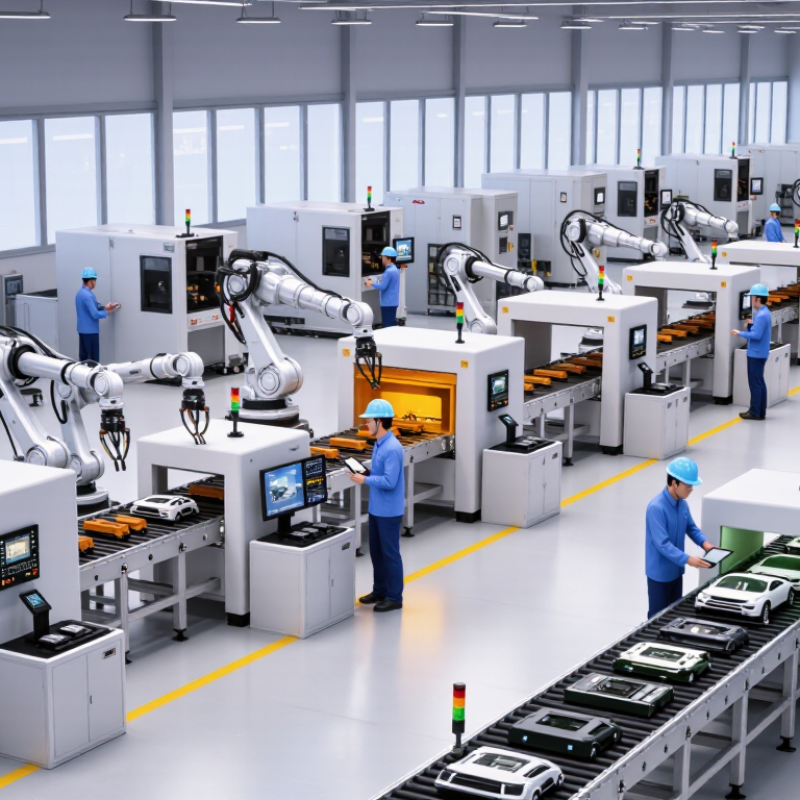
Chinese automation companies serve a wide range of industries, from electronics assembly to food processing. Their systems often combine robotic arms, machine vision, conveyors, sensors, and industrial software. In an electronics workshop, a vision camera can inspect circuit boards under bright, controlled lighting. A robotic gripper then places approved parts into trays within seconds. These applications reduce repetitive labor and improve production consistency.
Automated equipment also supports automotive, packaging, logistics, pharmaceutical, textile, and metalworking operations. In automotive plants, robots handle welding, painting, fastening, and material movement. Packaging lines use servo systems to fill, seal, label, and inspect products.
Warehouses may deploy guided vehicles to move cartons between storage racks and loading areas. Food manufacturers require stainless-steel structures, cleanable surfaces, and accurate temperature control. Small details matter here.
Buyer requirements can differ sharply by industry. A metalworking cell needs strong enclosures and dust protection, while a medical production line demands traceability and strict process control. During supplier evaluation, buyers should examine cycle-time data, safety documents, spare-parts access, and remote support procedures. Factory acceptance testing is useful, but it cannot reveal every problem. Operators may still need extra training after installation. That weakness deserves honest discussion. Chinese suppliers can offer flexible customization, yet unclear specifications may cause delays, integration costs, or disappointing results. Clear drawings, sample products, and measurable acceptance standards make cooperation more reliable.