Skip to content

Why Is Laser Automation Important for Manufacturers?

Why Is Laser Automation Important for Manufacturers?

A laser cell can cut, weld, mark, or texture parts with remarkable precision. But precision alone does not guarantee a productive factory. Operators still need to load fixtures, verify settings, manage material flow, and respond to interruptions. Laser automation connects these steps, helping manufacturers create repeatable workflows rather than isolated high-performance machines.

The scale of industrial automation is growing. The International Federation of Robotics reported 4,281,585 industrial robots operating worldwide in 2023, in its World Robotics 2024 report. Deloitte’s 2024 Smart Manufacturing Survey found that 86% of surveyed manufacturing executives expected smart manufacturing to be a primary driver of competitiveness within five years. These figures describe broad automation, not laser systems alone, but they show the direction of investment. Prof. Dr. Reinhart Poprawe, former director of Fraunhofer ILT and a specialist in laser manufacturing, has emphasized that laser technology creates value when integrated into the wider production process. In practice, that means coordinating the beam source with robotics, sensors, fixturing, and quality checks.

The benefits can be tangible: fewer manual handoffs, steadier cycle times, and more consistent weld seams across a shift. Yet automation is not a cure-all. Poor part presentation or weak process monitoring can simply make defects arrive faster. Manufacturers should assess the whole cell, including setup, maintenance, and operator training. The details matter. A well-designed system can improve throughput and traceability, while a poorly matched one may add cost without fixing the real bottleneck. Industry data offers a useful signal, not a promise for every factory.
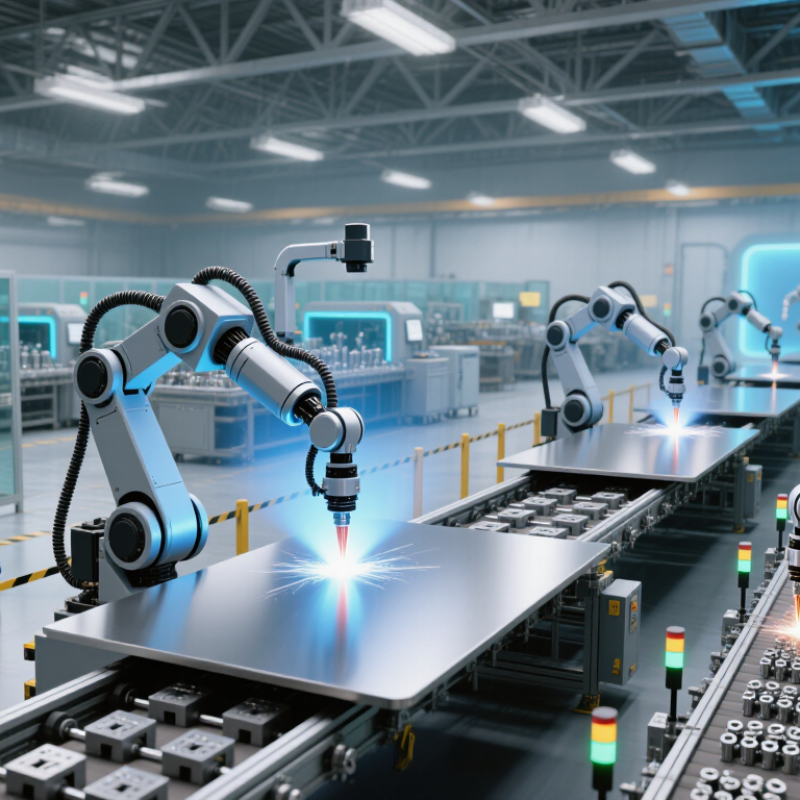
Why Is Laser Automation Important for Manufacturers?

What Laser Automation Covers: Cutting, Welding, Marking, and Inspection

Laser automation is a connected production process, not just a cutting machine. A laser cutter follows a programmed path through sheet metal; a welding cell joins parts with controlled heat and repeatable seams. Marking adds traceable codes or measurements, while inspection checks dimensions and surface defects before parts move downstream. One missed check can send a flawed component through several costly steps.

The scale of factory automation is growing. The International Federation of Robotics reported 541,302 industrial robots installed worldwide in 2023 in its World Robotics 2024 report. That figure covers industrial robots broadly, not laser systems alone, but it shows why manufacturers are investing in automated production. Laser processes can support that shift when fixtures, sensors, and software share reliable data. Not just speed. A faster cell still creates scrap if its inspection settings are wrong or its materials vary. Real production is rarely that tidy.

Tips: Test the complete process on representative parts. Check cut edges, weld consistency, marking readability, and inspection results under normal shift conditions. Record setup changes and review false rejects; a system that flags too much can slow work as surely as one that misses defects. Keep a human review step for uncertain results, especially during commissioning.

Why Is Laser Automation Important for Manufacturers? – What Laser Automation Covers: Cutting, Welding, Marking, and Inspection
Laser Process What Automation Covers Typical Materials or Applications Useful Quality Checks Manufacturing Value Important Consideration
Cutting Automated sheet or part loading, programmed cutting paths, nesting, assist-gas control, and part sorting. Commonly used for sheet metals such as mild steel, stainless steel, and aluminum; suitable plastics and other materials depend on the laser and process setup. Cut dimensions, edge condition, burrs, kerf, and presence of incomplete cuts. Repeatable part geometry, efficient material use through nesting, and reduced manual handling between operations. Results depend on material type and thickness, laser settings, assist gas, optics, and maintenance.
Welding Robot or motion-system control of the laser path, part positioning, seam tracking, and coordinated delivery of shielding gas where required. Joining compatible metal components, including steel and aluminum alloys, in assemblies that can be accurately fixtured. Seam position, weld continuity, bead dimensions, surface defects, and—when required—internal weld quality using an appropriate inspection method. Consistent programmed weld paths and reduced variation from manual positioning; concentrated heat input can help limit distortion in suitable applications. Joint fit-up, clamping, material reflectivity, thickness, and process settings affect weld quality and suitability.
Marking Programmed text, graphics, serial numbers, and codes; vision-guided part location; and automatic marking verification. Part identification and traceability on compatible metals, plastics, and other substrates, with settings selected for each material. Code readability, content accuracy, mark position, contrast, and mark presence. Supports consistent identification and product traceability while reducing manual labeling and data-entry errors. Mark appearance and readability vary with substrate, surface finish, marking method, and process parameters.
Inspection Automated cameras, sensors, or scanners capture part features and compare results with defined inspection criteria or reference data. In-process or post-process checks of cut profiles, weld seams, marked codes, and other visible features. Dimensional deviations, missing or misplaced features, visible surface anomalies, and code readability; internal defects require suitable nondestructive testing methods. Enables repeatable checks, faster feedback to production, and recorded inspection results for process monitoring. Lighting, part presentation, sensor resolution, calibration, and validated acceptance criteria affect inspection reliability.

Note: Capabilities and results vary by material, part geometry, equipment configuration, process parameters, and inspection requirements.


Where Laser Systems Fit in a Modern Manufacturing Workflow

Why Is Laser Automation Important for Manufacturers?

Where Laser Systems Fit in a Modern Manufacturing Workflow

A laser station works best as part of a connected production process, not as an isolated machine. A digital job file can guide cutting, marking, or welding, while fixtures hold each part in a repeatable position. Sensors can confirm alignment before the beam starts. Small details matter. A misplaced component may create scrap even when the laser settings are correct.

Upstream, operators need accurate drawings and material information. Downstream, inspection checks dimensions, surface quality, or code readability before parts move onward. Extraction and guarding also belong in the workflow, alongside planned maintenance and operator training. Not always. A highly automated cell can still stop when a fixture wears or material thickness varies. Manufacturers should test representative parts and track cycle time, defects, and changeover effort before expanding automation. The first setup may expose gaps in the process; that is useful evidence, not a reason to hide the results. Automation adds value when it makes work more consistent without making troubleshooting harder.

How Laser Automation Affects Throughput, Precision, and Process Consistency

Laser automation can raise throughput by keeping cutting, welding, or marking cycles moving with fewer manual handoffs. A robotic cell can follow programmed paths across repeated parts, while sensors and vision systems help detect position changes. Deloitte and MAPI’s 2019 Smart Factory study reported potential gains of 10–12% in factory output and labor productivity. Those figures describe smart factories broadly, not laser systems alone, so results depend on the application, setup, and maintenance.

Precision improves when motion, focus, and workpiece position stay controlled from cycle to cycle. That matters when a seam shifts slightly or a small feature must land in the same place on every part. Automated recipes also support process consistency by recording parameters such as speed and power. Still, automation will not repair poor fixturing or an inconsistent incoming part. Small details matter. The International Federation of Robotics reported 4.28 million industrial robots operating worldwide in 2023, reflecting the wider adoption of robotic production cells.

Tips: Track cycle time, rework, and dimensional variation before and after installation. Test representative parts, including difficult edge cases, before setting production targets. Keep a human review step for unusual defects; real shop-floor conditions can be messier than a clean trial run.

Why Is Laser Automation Important for Manufacturers?

Illustrative production-cell scenario: automation can increase throughput while reducing cycle-time variation. Values below are example estimates, not industry benchmarks.

What it shows: In this example, automated loading and processing raise output from 60 to 100 parts per hour and reduce cycle-time variation from 12 to 4 seconds. More consistent positioning and repeatable machine settings can support precision and process consistency; actual results depend on the part, equipment, and operating conditions.

How IFR’s 2023 Data—541,302 Robot Installations and 4.28 Million Robots—Frames Adoption

Why Is Laser Automation Important for Manufacturers?

541,302

industrial robot installations in 2023

4.28 million

robots operating worldwide

The International Federation of Robotics reported 541,302 industrial robot installations in 2023, with 4.28 million robots operating worldwide. These figures cover industrial robots broadly, not laser systems alone. Still, they show how deeply automation has entered manufacturing. Laser-equipped robots can repeat cutting, welding, or marking paths with steady speed and accuracy. That can reduce handling time and help keep product quality consistent across shifts. A robot is not a fix for every production problem.

For manufacturers, the value depends on the task. A laser cell may suit repeated welds on metal parts, while a high-mix line may need frequent setup changes. Automation can also reduce workers’ exposure to heat and fumes when the process is properly enclosed and monitored. But installation counts do not reveal whether each system is productive, affordable, or well matched to its factory. That distinction matters. Even advanced equipment can sit idle if programming, maintenance, or material flow is overlooked.

Tips

Start with one repeatable process. Measure cycle time, scrap, and changeover effort before investing. Check enclosure, extraction, and operator training needs. Ask technicians to review the workflow; their practical feedback may catch a detail the plan misses. Reassess after launch, because the first setup is rarely perfect.

How to Assess Safety, Integration, and Return on Investment Before Deployment

Before deployment, assess the actual laser task, not just the machine enclosure. Map beam paths, material handling, maintenance access, fumes, and foreseeable misloads. Document the risks, then verify guarding, interlocks, extraction, and emergency stops under real production conditions. A safe demo is not proof.

Integration deserves the same scrutiny. The International Federation of Robotics’ World Robotics 2024 report counted 4,281,585 industrial robots operating worldwide in 2023, up 10% from 2022. It also recorded 541,302 new installations. Automation is established, but it is not plug-and-play. Check control-system handshakes, part presentation, traceability, and recovery after a jam. Run a pilot with actual materials, operators, and shift patterns.

Build ROI from measured baseline data: cycle time, scrap, rework, uptime, maintenance, consumables, training, and safety equipment. Compare total installed cost with annual savings, using conservative, expected, and optimistic cases. A payback estimate can look precise while missing changeovers or awkward maintenance. That deserves a second look. Track first-pass yield and unplanned stops after launch; revise assumptions before expanding. Laser speed alone is not ROI.